
Last updated September 23, 2026
Free visual inspection and a written scope of work before any mitigation begins - photos, moisture readings, and drying logs go in your claim file
The scope we write is the scope we bill. Anything new gets shown to you, in writing, before we touch it.
Damage Restoration Cost Breakdown: The Spring Valley Homeowner’s Reference for 2026
The difference between a $9,000 water loss and a $22,000 water loss is often not the square footage of damage. It’s whether the affected materials are classified as Category 2 or Category 3 contamination, a determination made by the contractor in the first hour that the homeowner rarely witnesses or understands. In Spring Valley, where hard water mineral content and desert dust complicate every moisture assessment, that classification decision can add 40% to 60% to your final invoice before you’ve read past the first page of the estimate.
This guide and our more guides & resources decode every line item that appears on a restoration invoice in Spring Valley. You’ll learn how Xactimate line codes translate to dollar amounts, how equipment day-counts are calculated and verified, when overhead and profit charges are legitimate, and how to read your own estimate before signing anything. No restoration contractor in Spring Valley should expect you to approve a scope you cannot read. Haven Standard, Clause 1: a written price before work begins, every time, with no exceptions.
Quick Answer
Water damage restoration in Spring Valley costs between $3,200 and $18,500 for most residential losses, with whole-home Category 3 floods reaching $45,000 to $80,000. Mold remediation averages $2,800 to $7,500 for contained attic or crawlspace work, and $15,000 to $35,000 for whole-home HVAC-integrated remediation. Fire and smoke damage restoration ranges from $8,500 to $35,000 depending on whether structural reconstruction is required. Every legitimate invoice breaks down into labor units, equipment day-counts, material line items, and overhead and profit, each calculated against Xactimate’s Clark County pricing tables.
Table of Contents
- How Xactimate Pricing Works in Spring Valley
- Water Damage Restoration Costs by Category
- Mold Remediation Pricing and Scope Variables
- Fire & Smoke Damage Restoration Costs
- Equipment Costs: Reading the Daily Rates
- Spring Valley Labor Rates vs. National Defaults
- When 10% and 10% Overhead and Profit Is Legitimate
- Documentation That Gets Insurance Claims Paid
How Xactimate Pricing Works in Spring Valley
Xactimate is the pricing engine that drives nearly every restoration invoice in the United States, including every estimate written in Spring Valley. Insurance adjusters and contractors both use it, but they rarely explain to homeowners how the numbers are generated. Understanding three core concepts, line codes, unit counts, and geographic modifiers, lets you verify any estimate line by line.
Every Xactimate line item contains a code, a description, a unit of measurement, a unit price, and a quantity. The code matters because it determines what labor and materials are bundled into that price. WTR241, for example, is “Water Extraction, Carpet, Light” and includes the extractor, the technician’s labor to operate it, and the disposal of extracted water. MLD251 is “Mold Remediation, Containment, Polyethylene Barrier, Setup and Takedown” and includes the poly sheeting, tape, labor to build the containment, and labor to remove it. The unit price for each code is set by Xactimate’s geographic pricing database, which updates quarterly and reflects local labor rates, material costs, and equipment rental rates.
For Spring Valley, Xactimate uses the Clark County, Nevada pricing region. In 2026, that region carries a labor multiplier of approximately 1.12 to 1.15 above the national base, reflecting higher electrician and plumber rates in the Las Vegas metro area. Material multipliers run closer to 1.08, since drywall, insulation, and flooring ship efficiently into this market. Equipment rental multipliers are 1.00, matching national averages, because dehumidifier and air mover rental rates are standardized across major markets through national distributor networks.
Here’s how a typical water damage line item reads on an estimate:
- WTR241 - Water Extraction, Carpet, Light - 450 sq ft @ $0.87/sq ft = $391.50
- WTR340 - Dehumidifier, LGR, Large - 4 days @ $89.50/day = $358.00
- WTR370 - Air Mover, 1/2 HP - 6 units, 4 days @ $24.75/day each = $594.00
- WTR410 - Antimicrobial Application, Category 2 - 450 sq ft @ $0.42/sq ft = $189.00
The total for these four lines: $1,532.50. A complete water loss in Spring Valley typically contains 15 to 40 such lines. The contractor’s job is to justify each line with documented measurements. Your job as a homeowner is to verify that the quantities match what was actually deployed and what the drying logs record, as covered in our Damage Restoration Warning Signs: A Spring Valley Homeowner’s Reference Guide.
At DryMark Restoration Spring Valley home, every estimate is delivered with a room-by-room scope sheet that maps each Xactimate code to a specific location in your home. Haven Standard, Clause 1: written price before work begins. No exceptions.
Water Damage Restoration Costs by Category
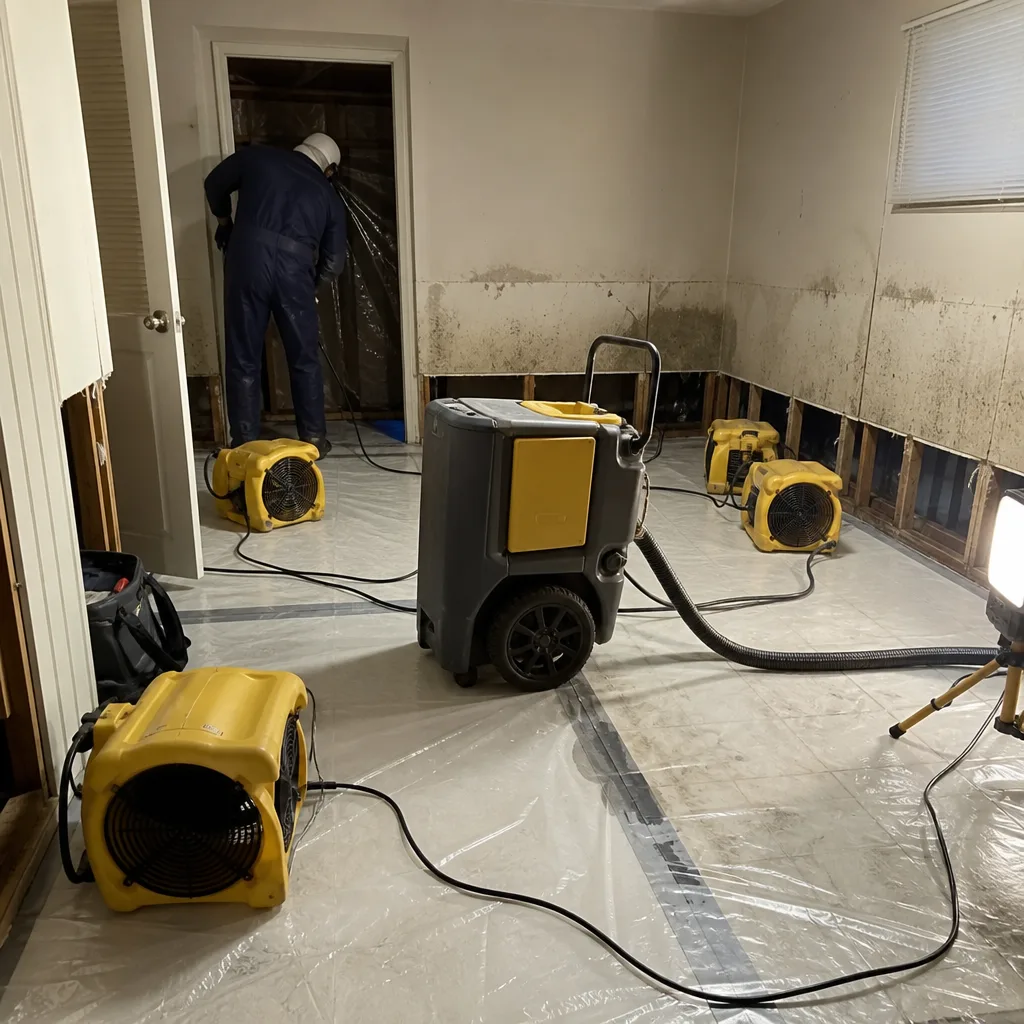
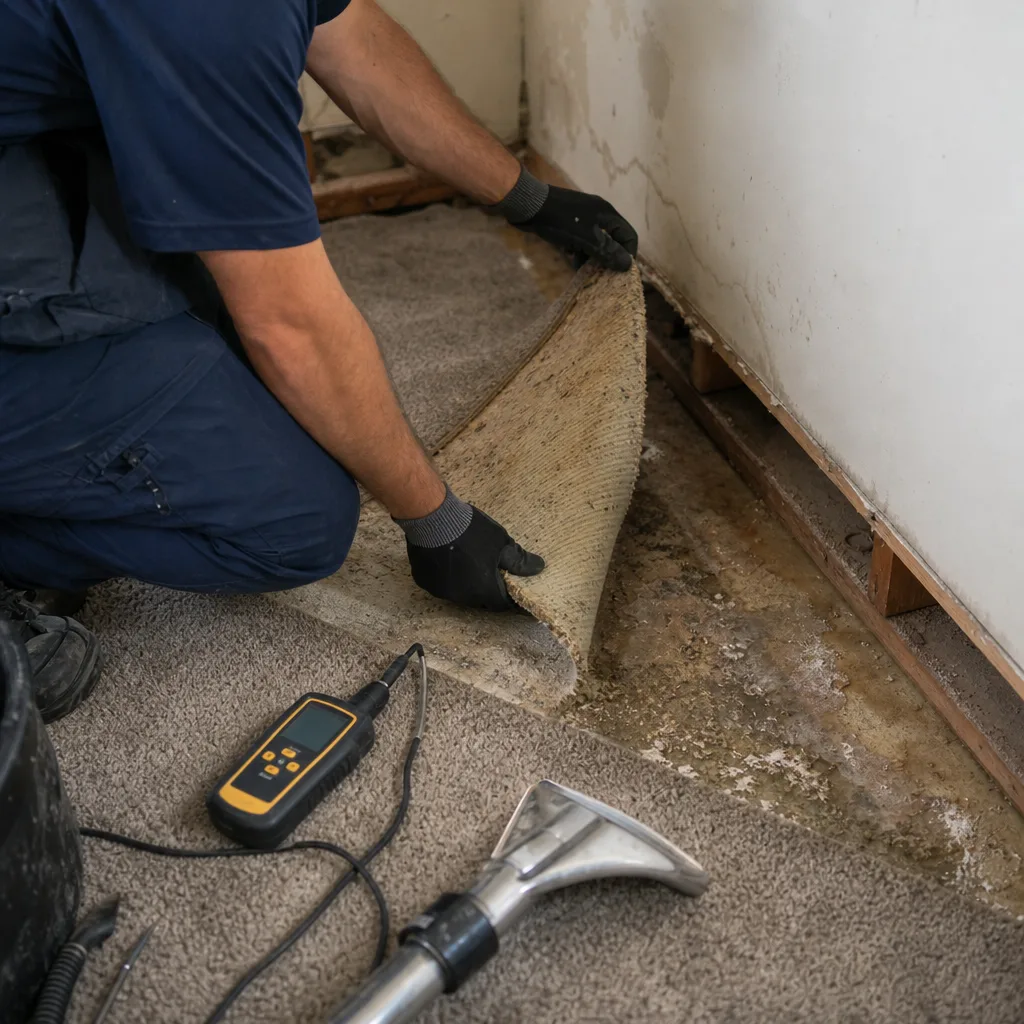
Water damage restoration in Spring Valley breaks into three contamination categories, and the category assigned to your loss is the single largest cost driver on the invoice. The category is determined by the water source, not by how dirty the water looks when you first see it.
Category 1: Clean Water originates from a sanitary source, a broken supply line, a tub overflow with no contaminants, or a water heater rupture. In Spring Valley, where water hardness runs 280 to 350 ppm, even clean water carries enough mineral content to leave residue on drywall and flooring. Category 1 losses average $3.20 to $4.50 per square foot of affected area for extraction and drying, with reconstruction adding $2.50 to $4.00 per square foot depending on finish materials. A 1,200 square foot Category 1 loss with 30% structural involvement typically invoices at $3,800 to $6,200 for mitigation, plus $2,800 to $5,500 for reconstruction.
Category 2: Gray Water contains significant contamination and has the potential to cause discomfort or sickness if contacted or consumed. Sources include dishwasher discharge, washing machine overflow, and sump pump failures. The critical cost multiplier here is antimicrobial treatment, padding and carpet disposal (rather than cleaning), and the requirement for HEPA air scrubbing during drying. Category 2 losses run $5.50 to $8.50 per square foot for mitigation. That same 1,200 square foot loss, reclassified as Category 2, now invoices at $6,600 to $10,200 for mitigation alone. The difference from Category 1 is not extraction labor, it’s the disposal of porous materials, the application of antimicrobial agents, and the extended drying timeline required by IICRC S500 standards.
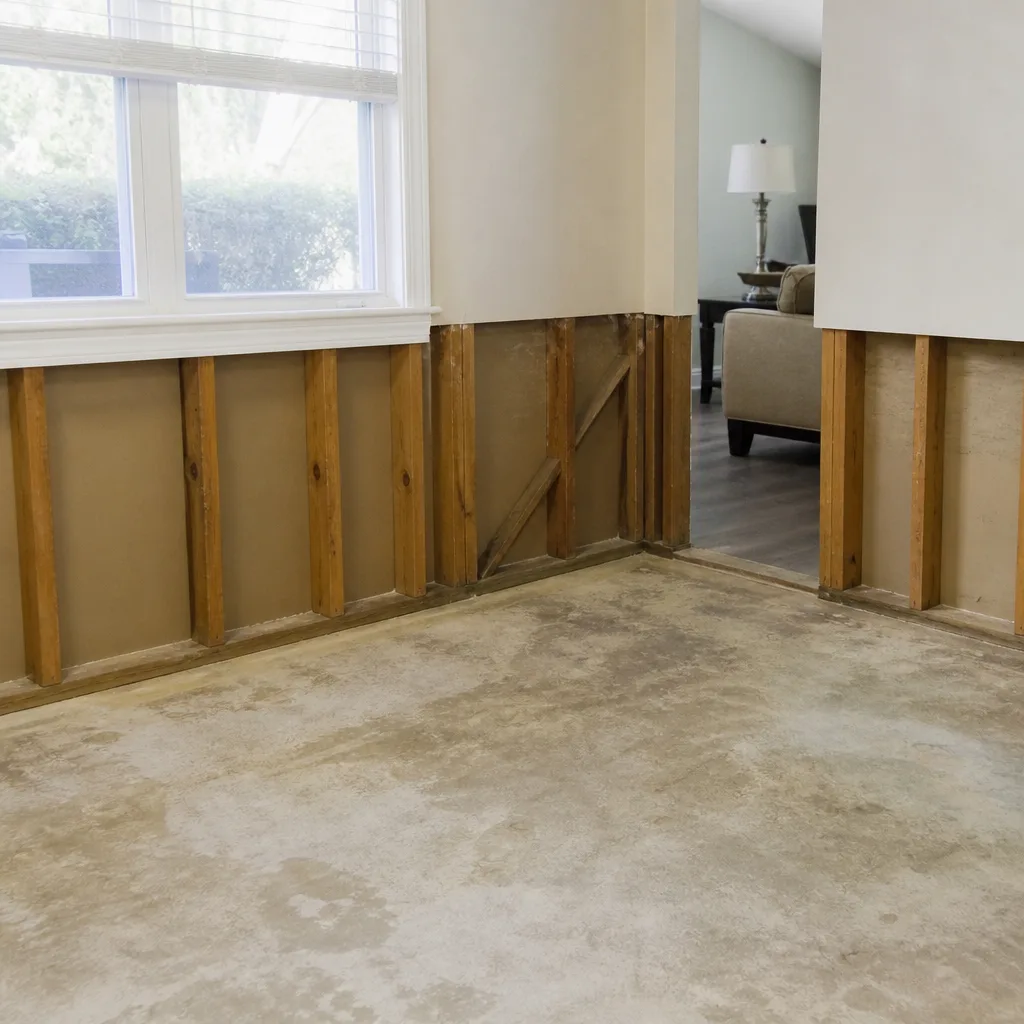
Category 3: Black Water is grossly contaminated and can contain pathogenic, toxigenic, or other harmful agents. Sources include sewage backup, flooding from rivers or streams, and water that has stood long enough to support microbial growth. In Spring Valley’s desert climate, standing water reaches Category 3 classification faster than in humid climates, typically within 48 to 72 hours rather than the 72 to 96 hours common in Gulf Coast regions. Category 3 mitigation runs $9.00 to $14.00 per square foot, with the 1,200 square foot loss now reaching $10,800 to $16,800 for mitigation. All porous structural materials must be removed, subfloors require antimicrobial sealing, and drying equipment runs 25% to 40% longer due to the required decontamination phase.
Here’s how the three categories compare for the same hypothetical loss:
| Category | Mitigation Cost | Reconstruction Cost | Total Range |
|---|---|---|---|
| Category 1 (Clean) | $3,200 – $6,200 | $2,800 – $5,500 | $6,000 – $11,700 |
| Category 2 (Gray) | $6,600 – $10,200 | $3,500 – $6,800 | $10,100 – $17,000 |
| Category 3 (Black) | $10,800 – $16,800 | $5,200 – $9,500 | $16,000 – $26,300 |
The category determination should be documented with a specific water source identification and, for Category 2 or 3, a microbial assessment with sampling results. If your contractor cannot produce that documentation, the classification is suspect and may warrant a Water Damage Restoration in Spring Valley second opinion. DryMark Restoration Spring Valley provides free second opinions on any competitor’s written estimate.
Mold Remediation Pricing and Scope Variables
Mold remediation in Spring Valley carries unique cost drivers that don’t appear in water damage estimates. The desert climate creates a specific pattern: mold growth is often concentrated in HVAC systems and attic spaces where temperature differentials cause condensation, rather than the widespread surface growth common in humid climates. This means Spring Valley mold jobs are more likely to require containment of mechanical systems and less likely to involve whole-room demolition.
Xactimate mold codes break into containment, removal, cleaning, and clearance testing categories. MLD251, the polyethylene containment setup, runs $285 to $420 per contained area depending on ceiling height and complexity. MLD260 covers HEPA vacuuming of surfaces within containment at $0.65 to $0.90 per square foot. MLD270, antimicrobial application to remaining structural materials, adds $0.45 to $0.75 per square foot. These three codes form the core of most remediation scopes.
The scope variables that drive cost are:
- Containment complexity. A rectangular attic space with gable vent access requires simple poly sheeting and negative air pressure. An HVAC-integrated crawlspace with multiple duct penetrations requires custom containment around each penetration, often doubling the MLD251 unit count.
- Material classification. Mold on non-porous materials (tile, metal, sealed wood) is HEPA vacuumed and cleaned in place. Mold on porous materials (drywall, insulation, unsealed wood) requires removal and disposal. The labor ratio is approximately 1:4, one hour of cleaning versus four hours of removal and replacement for the same surface area.
- HVAC involvement. When mold colonizes ductwork, remediation requires duct cleaning per NADCA standards, often with camera verification. This adds $450 to $850 per air handler and $12 to $18 per linear foot of ductwork. In Spring Valley’s single-story ranch and mid-century modern housing stock, systems often run 80 to 140 linear feet.
- Clearance testing. Post-remediation verification by an independent industrial hygienist runs $450 to $750 for air sampling and $650 to $1,100 for ERMI/HERSTMI-2 dust analysis. Some contractors bundle this into their scope; others require the homeowner to arrange it separately. The Haven Standard requires documentation of clearance before containment removal, with the method specified in the written scope.
Typical Spring Valley mold remediation costs:
- Contained attic or crawlspace, no HVAC: $2,800 – $5,500
- Contained attic or crawlspace with HVAC integration: $6,500 – $12,000
- Whole-home HVAC-integrated remediation: $15,000 – $35,000
- Post-flood mold secondary to delayed drying: $8,500 – $22,000 (mitigation plus remediation)
In the Rancho Drive and Charleston Heights neighborhoods, we’ve seen repeated instances of attic mold secondary to bathroom exhaust fans vented into soffits rather than through the roof. The remediation is straightforward, but the source correction, proper roof venting, adds $800 to $1,400 that many homeowners don’t anticipate. A written scope should identify source correction as a separate line item or explicitly exclude it with a note that deferred correction will likely result in recurrence.
Mold Remediation in Spring Valley requires specific documentation: pre-remediation photos with moisture readings, containment photos, daily air scrubber run-time logs, and post-remediation clearance results. DryMark Restoration Spring Valley delivers all four as standard, never as an upsell.
Fire & Smoke Damage Restoration Costs
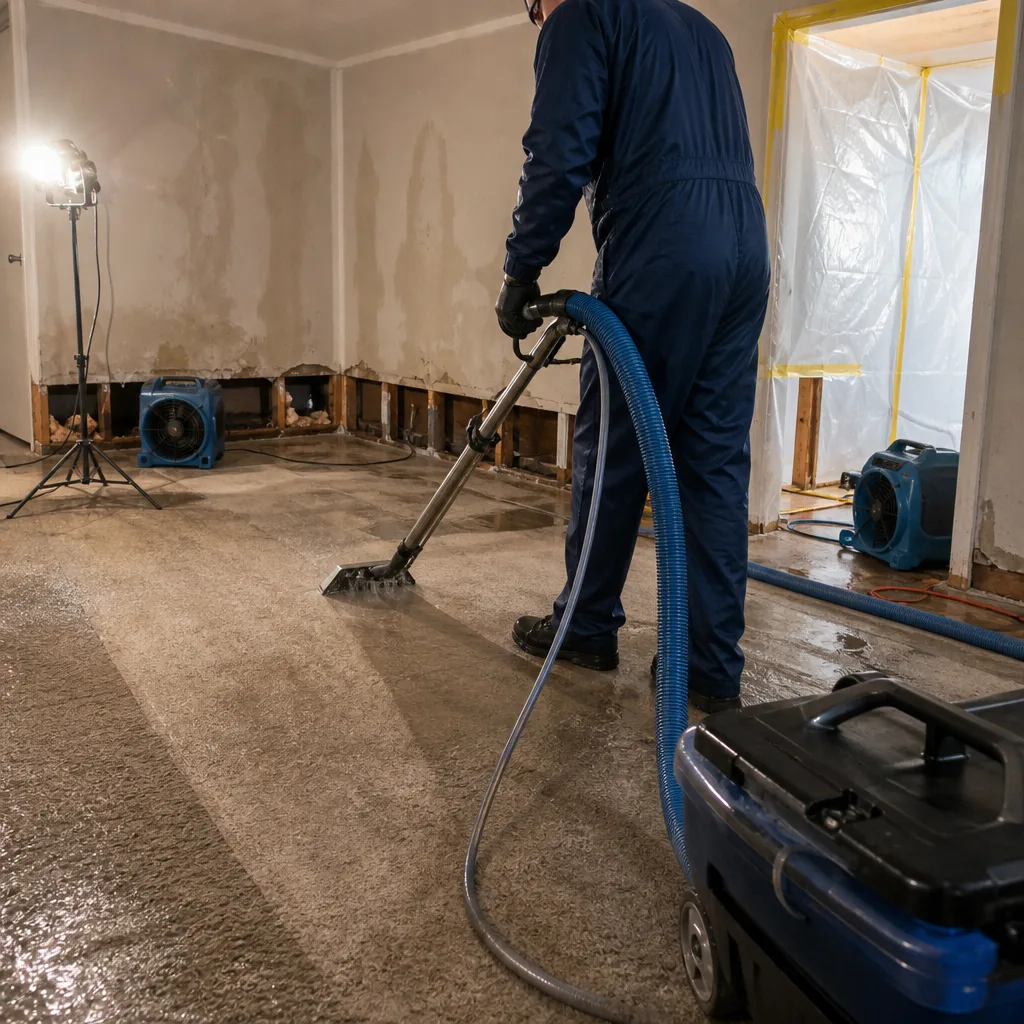
Fire damage restoration in Spring Valley follows a different cost structure than water or mold, because the initial emergency phase, board-up and structural stabilization, is often followed by a extended contents evaluation and reconstruction period that can span months. The mitigation-to-reconstruction ratio is typically 1:3 or 1:4, meaning a $12,000 mitigation invoice often precedes a $36,000 to $48,000 reconstruction scope.
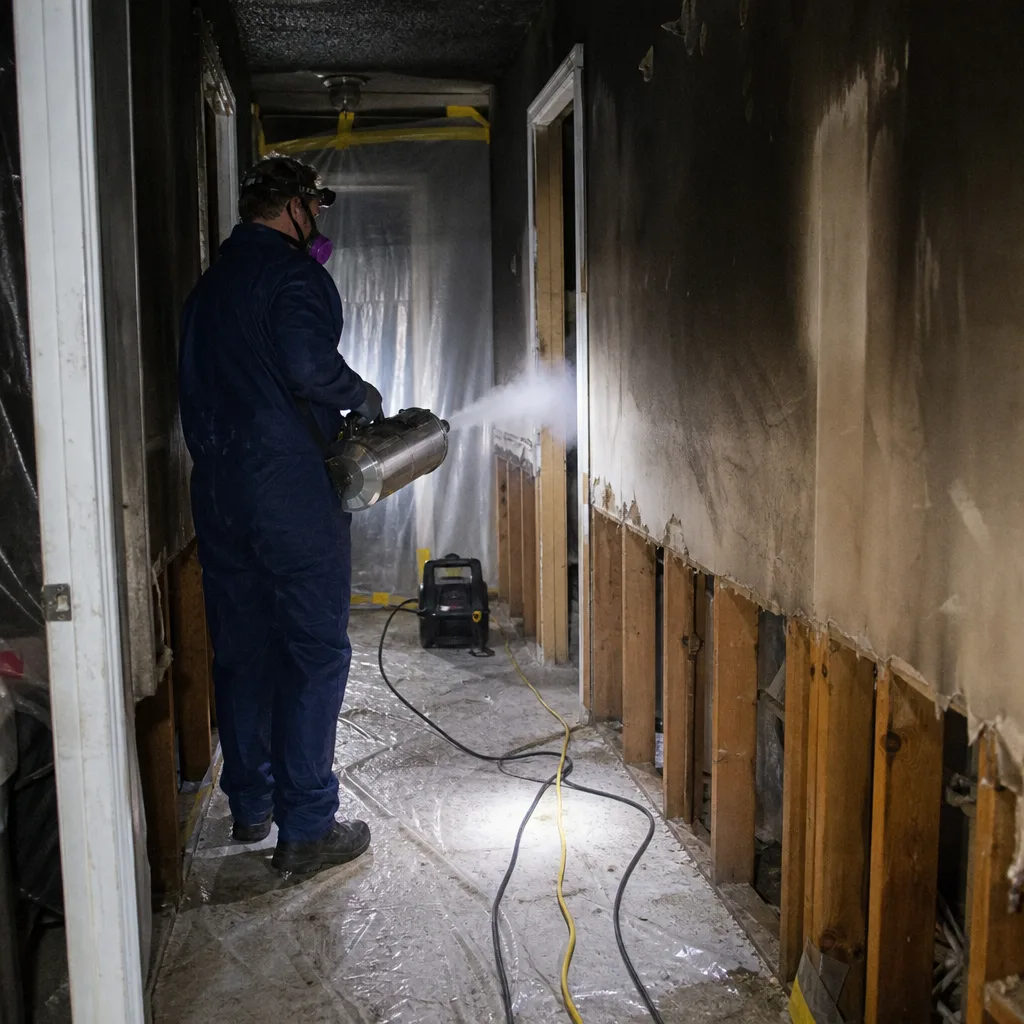
Xactimate fire codes begin with FRM (fire remediation) and SMO (smoke odor) prefixes. FRM100 covers emergency board-up and security, priced per linear foot of opening secured at $8.50 to $14.00 per foot depending on height and material. SMO100 is “Odor Counteractant, Thermal Fogging, Light to Moderate” at $0.85 to $1.25 per square foot of affected area. SMO200, ozone treatment, runs $185 to $285 per treatment zone per day.
The cost drivers specific to fire restoration are:
- Soot classification. Dry soot from fast-burning, oxygen-rich fires cleans more readily than wet soot from slow, smoldering fires. Wet soot requires specialized cleaning agents and often mandates replacement of porous materials that dry soot would allow to be restored. The labor multiplier between dry and wet soot cleaning is approximately 1.8 to 2.2.
- Structural involvement. When fire compromises trusses, joists, or load-bearing walls, engineering evaluation and permit drawings are required. In Spring Valley, Clark County building department permit fees for fire reconstruction run $450 to $850 for residential projects, with plan review adding 2 to 4 weeks to the timeline. These costs belong on the estimate as separate line items, not buried in overhead and profit.
- Contents pack-out and cleaning. Non-restorable contents are inventoried for insurance replacement. Restorable contents are packed, cleaned off-site, and stored until reconstruction completes. Pack-out costs run $4.50 to $7.50 per cubic foot, with cleaning at $2.50 to $5.00 per cubic foot depending on contamination level. Storage is typically $0.35 to $0.55 per cubic foot per month.
- HVAC and duct contamination. Fire smoke infiltrates ductwork rapidly. Duct cleaning after fire damage runs 40% to 60% above standard cleaning rates due to soot particulate loading, typically $18 to $28 per linear foot versus $12 to $18 for standard residential duct cleaning.
Typical Spring Valley fire restoration cost ranges:
| Loss Type | Mitigation | Reconstruction | Contents | Total Range |
|---|---|---|---|---|
| Kitchen grease fire, limited spread | $4,500 – $8,500 | $12,000 – $22,000 | $3,500 – $8,000 | $20,000 – $38,500 |
| Electrical fire, moderate structural | $8,500 – $15,000 | $25,000 – $45,000 | $8,000 – $18,000 | $41,500 – $78,000 |
| Whole-home fire, major structural | $15,000 – $28,000 | $55,000 – $95,000 | $15,000 – $35,000 | $85,000 – $158,000 |
Spring Valley’s mid-century housing stock, particularly in the Paradise Palms and John S. Park areas, contains original lath-and-plaster walls that complicate smoke odor remediation. Plaster is non-porous and restorable, but the wood lath behind it absorbs odor and requires injection of odor counteractant through drilled access holes. This technique, coded SMO350 in Xactimate, adds $2.50 to $4.00 per square foot of wall area but avoids the $8.00 to $12.00 per square foot cost of plaster demolition and replacement. A contractor who defaults to demolition without evaluating lath injection is adding unnecessary cost.
Fire & Smoke Damage Restoration in Spring Valley requires photo documentation of every contents item before pack-out, every structural element before demolition, and every reconstruction phase before concealment. DryMark Restoration Spring Valley’s daily photo record is included as a standard deliverable on every fire job.
Equipment Costs: Reading the Daily Rates
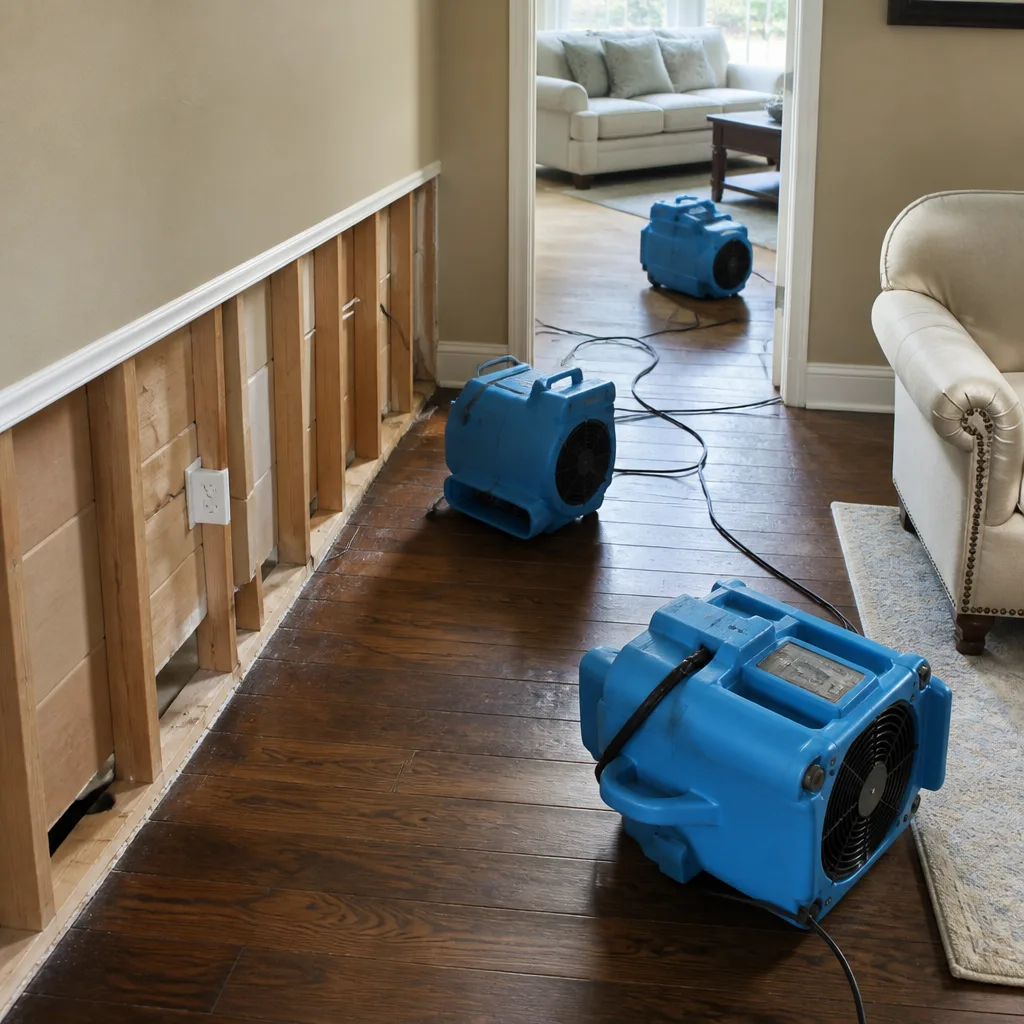
Equipment rental is the most frequently disputed line item on restoration invoices, because homeowners rarely see the equipment after initial deployment and have no independent verification of how many days it ran. Understanding daily rates and how to verify day-counts against drying logs protects you from both honest errors and deliberate overbilling.
Standard Spring Valley equipment rates in 2026 Xactimate pricing:
| Equipment Type | Xactimate Code | Daily Rate | Typical Deployment |
|---|---|---|---|
| LGR Dehumidifier, Large (e.g., Dri-Eaz LGR 7000XLi) | WTR340 | $89.50 | 1 per 500-700 sq ft affected |
| LGR Dehumidifier, XL (e.g., Phoenix 200 MAX) | WTR341 | $112.00 | 1 per 800-1,000 sq ft or high-ceiling spaces |
| Air Mover, 1/2 HP (e.g., B-Air Grizzly) | WTR370 | $24.75 | 1 per 50-70 linear ft of wall |
| Air Mover, 3/4 HP (e.g., XPOWER X-830) | WTR371 | $31.50 | High-velocity drying, carpet pad extraction |
| HEPA Air Scrubber (e.g., Dri-Eaz HEPA 500) | WTR380 | $68.00 | 1 per contained area or 600 sq ft |
| Injectidry HP60 Panel System | WTR390 | $145.00 | Hardwood floor drying, 1 per 100 sq ft |
| Negative Air Machine | WTR381 | $78.50 | Mold remediation containment |
| Thermal Imaging Camera | WTR395 | $185.00 | Initial assessment, daily monitoring |
The verification process is straightforward but requires specific documentation. Every legitimate restoration contractor produces daily drying logs that record:
- Equipment serial numbers or asset tags for each unit deployed
- Date and time of placement and removal
- Daily psychrometric readings: temperature, relative humidity, and specific humidity at the dehumidifier intake and at the affected structural materials
- Moisture content readings of affected materials, recorded by species (softwood, hardwood, drywall, concrete) using a calibrated pin or pinless meter
- Technician signature and timestamp
Day-count disputes arise most often when equipment is left running after materials have reached dry standard. IICRC S500 defines dry standard as moisture content within 4 percentage points of a dry, unaffected control sample of the same material in the same building. For gypsum drywall in Spring Valley’s climate, that’s typically 8% to 12% moisture content. For softwood framing, 10% to 14%. Equipment that runs beyond dry standard is not medically necessary, to use an analogy homeowners understand, and should not be billed.
Conversely, equipment removed before dry standard is reached can leave trapped moisture that supports mold growth. The drying log is the only evidence that the correct timeline was observed. At DryMark Restoration Spring Valley, we deliver the complete drying log with every invoice, not upon request. The log is your documentation for insurance submission and your protection against future mold claims.
Spring Valley Labor Rates vs. National Defaults
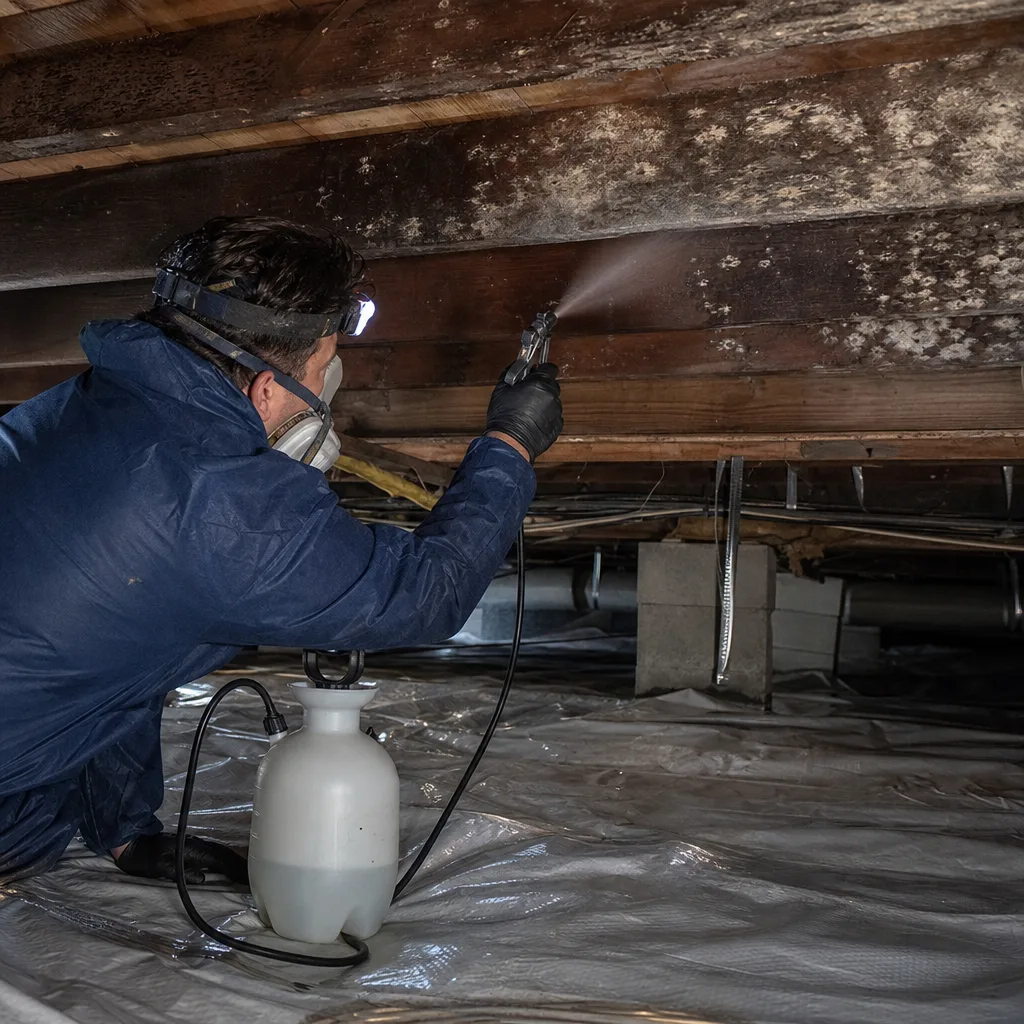
Xactimate’s base labor rates are national averages adjusted by geographic multipliers. For Spring Valley, falling within the Las Vegas-Paradise-Henderson MSA, the 2026 residential restoration labor rates are:
- Water Technician (WTR): $58.50/hour base, $65.50/hour with Clark County modifier
- Mold Remediation Technician (MLD): $62.00/hour base, $69.50/hour with modifier
- Fire/Smoke Technician (FRM/SMO): $64.50/hour base, $72.00/hour with modifier
- Contents Technician (CON): $48.00/hour base, $53.50/hour with modifier
- Supervisor/Estimator: $78.00/hour base, $87.50/hour with modifier
These rates include burden, payroll taxes, workers compensation, and basic overhead allocation. They do not include the 10% and 10% overhead and profit discussed in the next section, which is calculated on top of the loaded labor rate.
The gap between national default and Spring Valley actual creates two situations homeowners should understand. First, when an out-of-area adjuster uses default national rates, the estimate will understate Spring Valley costs by 12% to 15%. This is legitimate grounds for a supplement, and your contractor should file it with documented local rate verification. Second, when a contractor uses national default rates on a private-pay estimate while billing actual Spring Valley rates, the homeowner faces an unexpected balance. The written scope should specify which rate table applies.
In the Spring Valley market specifically, we’ve observed that electrician and plumber rates spike during peak summer months, June through September, when air conditioning failures cause water losses that require electrical panel work or refrigerant line repair. The seasonal surge can push effective rates 20% above the Xactimate quarterly average. A contractor who doesn’t account for this in the initial scope may return with change orders, which violates Haven Standard, Clause 1. Our practice is to note seasonal risk in the written scope and price the contingency transparently, not to bury it in vague language.
When 10% and 10% Overhead and Profit Is Legitimate
Overhead and profit, abbreviated O&P, appears on restoration estimates as two separate 10% calculations: 10% for overhead and 10% for profit, applied to the sum of labor, materials, and equipment. It’s one of the most contentious line items in insurance claims, and understanding when it’s legitimately owed can save thousands in disputed balances.
Overhead covers the contractor’s fixed costs: facility rent, insurance, vehicle fleet, administrative staff, training, and equipment maintenance. Profit is the net margin that funds business growth and owner return. Together, 10% and 10% equals approximately 18.2% of the subtotal, not 20%, because the second 10% is calculated on the subtotal plus the first 10%.
The critical question is whether the job requires general contractor coordination of three or more unrelated trades. When it does, O&P is standard and defensible. Examples include fire reconstruction requiring framing, electrical, plumbing, HVAC, drywall, flooring, and painting, with permits, inspections, and scheduling coordination; see Damage Restoration Permits, Codes & Inspections in NV: What You Need to Know for details. When it doesn’t, O&P is often challenged by adjusters and should be questioned by homeowners.
Specific scenarios for Spring Valley restoration:
| Job Type | O&P Appropriate? | Typical Challenge |
|---|---|---|
| Water mitigation only (extraction, drying, no rebuild) | No | Adjuster will deny; homeowner should not pay |
| Water mitigation + direct-hire reconstruction by same contractor | Marginal | Often negotiated to 5% and 5% or single 10% |
| Mold remediation with self-contained scope | No | Specialty trade, no GC coordination required |
| Fire reconstruction with 4+ trades and permit coordination | Yes | Standard, document trade coordination in writing |
| Storm damage with roofing, siding, windows, interior | Yes | Multiple trades, often multiple permits |
The Haven Standard addresses O&P explicitly: when it’s included, the written scope must list the trades being coordinated, the permit numbers or permit-ready status, and the inspection schedule. If a contractor includes O&P on a water mitigation-only job and cannot produce that documentation, the charge is not justified under our standard and should be disputed.
We’ve reviewed competitor estimates in Spring Valley where O&P was applied to equipment rental subtotals alone, a practice that inflates the invoice by 18.2% on the highest-margin line items. Xactimate equipment rates already include the rental company’s overhead and profit; adding contractor O&P on top is double recovery and is not standard practice.
Documentation That Gets Insurance Claims Paid
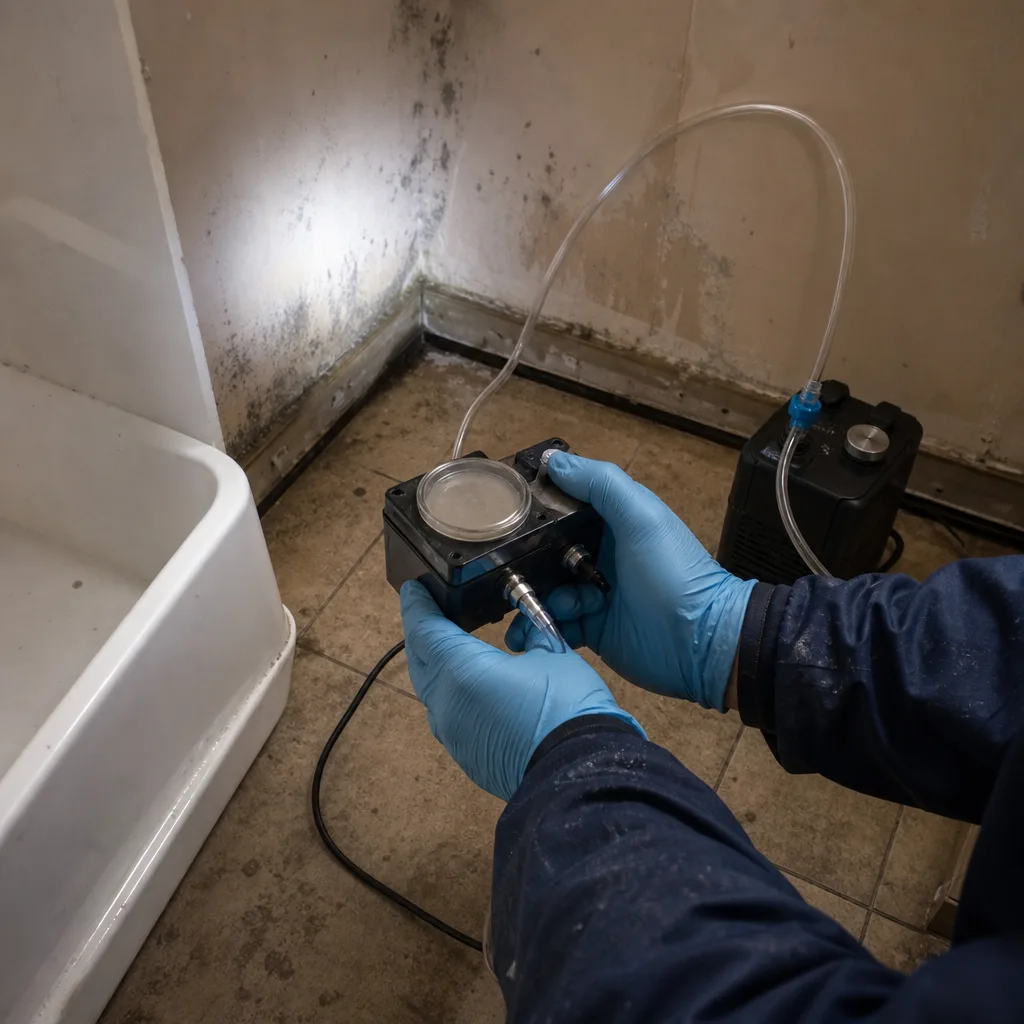
The documentation gap is the single largest reason restoration invoices are denied, reduced, or delayed in payment. It was the problem Alicia Brennan encountered repeatedly as a claims adjuster before founding Back to Dry in 2011, and it remains the core problem the company was built to solve. Insurance companies do not deny claims because they are malicious; they deny claims because the documentation does not meet the burden of proof established in the policy contract.
The documentation package that satisfies that burden contains six elements:
- Cause and origin determination. A specific, dated statement of what failed and why, with photos of the failure point before repair. For a water heater rupture: the model number, age, failure mode (tank seam, relief valve, inlet connection), and a photo of the failure.
- Pre-mitigation moisture mapping. A floor plan or room list with moisture content readings for every affected material, recorded with meter type, calibration date, and reading location. “Living room drywall, north wall, 24″ above baseboard: 28% moisture content, pin meter, calibrated 03/15/2026.”
- Daily drying logs with psychrometric data. Temperature, relative humidity, and specific humidity readings at the dehumidifier and at the drying environment, recorded at consistent intervals, typically every 24 hours. The goal is to demonstrate that the drying environment was controlled to IICRC S500 standards, not merely that equipment was present.
- Material classification and disposal documentation. For Category 2 or 3 losses, a manifest of disposed materials with quantity, classification, and disposal facility. For hazardous materials, a waste manifest with generator ID and transporter documentation.
- Post-mitigation verification. Moisture readings demonstrating dry standard achievement, with control sample comparison. For mold remediation, independent clearance testing with laboratory report.
- Photo record with timestamps and descriptions. Every visit, every phase, every critical finding. Not a handful of representative photos, but a complete visual record that reconstructs the loss timeline for an adjuster who never visited the site.
This documentation package is not an upsell. At DryMark Restoration Spring Valley, it is the standard deliverable on every job, produced by technicians trained to IICRC, RIA, and IFA standards and equipped to document to those standards. The photo record, the drying log, the written scope, and the signed 365-Day Done Right Promise are delivered at job completion, not upon request.
Direct insurance billing is available, with adjuster coordination handled by our documentation team. The same package that protects the homeowner from balance billing protects the adjuster from audit failure. When documentation is complete, payment follows. We’ve processed 12,000+ homes since 2011 on that principle.
Common Mistakes to Avoid
- Approving an estimate without Xactimate line codes. A narrative estimate with round-number totals, “$4,500 for drying,” cannot be verified against any standard pricing database. Demand line-item detail with codes.
- Accepting a Category 3 classification without documented microbial testing. In Spring Valley’s climate, standing water becomes Category 3 faster than in humid regions, but that classification still requires specific documentation, not the contractor’s visual assessment alone.
- Ignoring equipment day-count verification. Equipment left running past dry standard inflates invoices by $200 to $400 per day. Review drying logs before final billing.
- Paying O&P on mitigation-only scopes. Without three or more coordinated trades and permit management, overhead and profit is not standard practice and should be challenged.
- Failing to document pre-existing conditions. Spring Valley’s hard water causes chronic fixture deterioration that insurers may attribute to the claimed loss. Photo documentation of pre-existing conditions protects against coverage disputes.
- Delaying the call to document. The first 24 hours determine whether a loss is Category 1 or escalates to Category 2 or 3. Documentation begins with the emergency response, not after the fact.
- Not requesting the second opinion. DryMark Restoration Spring Valley provides free second opinions on any competitor’s written estimate. A second set of eyes on a $15,000 to $30,000 scope is not excessive caution; it’s standard due diligence.
When to Call a Professional
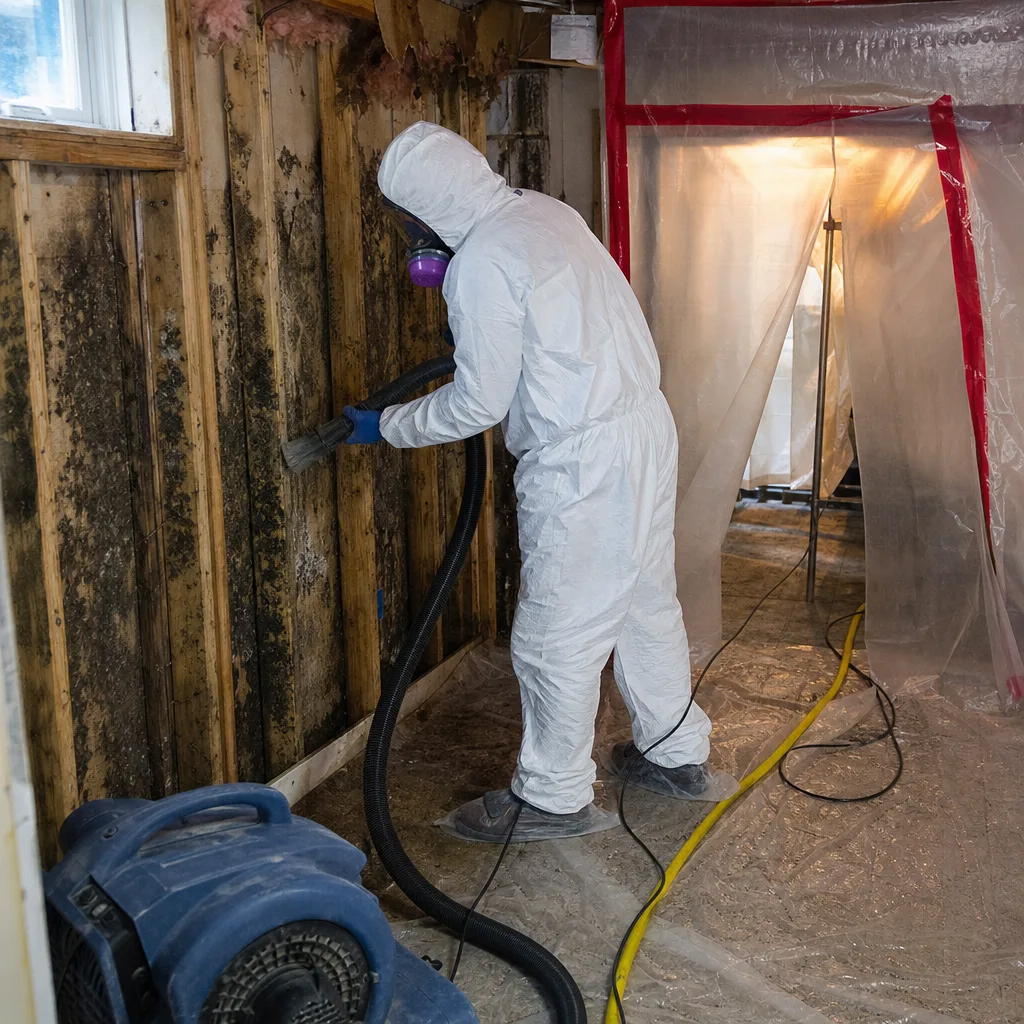
Call a restoration professional when water has affected more than a single small room, when the water source is unknown or potentially contaminated, when mold is visible or suspected, when fire or smoke damage extends beyond a single contained incident, or when structural elements are compromised. These are not DIY situations, as we explain in DIY vs Professional Damage Restoration: The Spring Valley Homeowner’s Decision Guide; the documentation requirements alone, for insurance and for your own protection, demand professional handling.
In Spring Valley, where summer temperatures exceed 110°F and monsoon season brings sudden, intense water intrusion, the window between manageable damage and structural compromise is shorter than many homeowners expect. A supply line failure on a second floor can saturate first-floor ceilings within 4 to 6 hours; a roof leak during a July thunderstorm can introduce Category 3 water if drainage systems are overwhelmed.
DryMark Restoration Spring Valley offers free estimates in Spring Valley. Our live phone coverage is available 24 hours a day, 7 days a week with no voicemail on emergency lines. Call (702) 430-2725 for a written scope before any work begins, documented to the standards that get claims paid.
Frequently Asked Questions
Most residential water damage restoration in Spring Valley ranges from $3,200 to $18,500 depending on contamination category, affected square footage, and whether reconstruction is included. Category 1 clean water losses average $3.20 to $4.50 per square foot for mitigation; Category 3 black water losses run $9.00 to $14.00 per square foot. Call (702) 430-2725 for a written estimate specific to your loss.
Insurance coverage depends on your policy terms, the cause of loss, and the documentation quality of your claim. Sudden and accidental water damage from a burst pipe is typically covered; gradual leaks and maintenance-related failures are often excluded. The single largest factor in full payment is complete documentation: moisture mapping, drying logs, photo records, and a written scope. DryMark Restoration Spring Valley produces this documentation as standard on every job to support your claim submission.
Emergency water mitigation crews in Spring Valley typically arrive within 60 to 90 minutes for active, ongoing losses. Response time depends on current storm or event volume; during major monsoon events, multiple-company coordination may be necessary. Our live dispatch answers every call 24 hours a day, 7 days a week with no voicemail, and provides realistic arrival estimates based on current crew locations. For reconstruction work, scheduling is by appointment with a written scope delivered before work begins.
Category 2 gray water mitigation costs $5.50 to $8.50 per square foot; Category 3 black water costs $9.00 to $14.00 per square foot. The cost difference comes from mandatory disposal of porous materials, extended drying timelines, antimicrobial treatment requirements, and more intensive documentation for disposal and clearance. A 1,200 square foot loss can increase by $4,000 to $6,000 solely based on this classification.
Visible mold on a small, non-porous surface in a contained area may be addressable with proper PPE and cleaning agents. However, mold in HVAC systems, inside wall cavities, or covering more than 10 square feet requires professional remediation per IICRC S520 standards. In Spring Valley, where mold often colonizes attic spaces and ductwork due to temperature differential condensation, professional assessment with moisture mapping and air sampling is the only way to determine true scope. Self-treatment of hidden mold typically results in recurrence and higher eventual costs.
The restoration contractor should provide direct adjuster coordination as part of their service, including scope submission, supplement negotiation, and documentation delivery. At DryMark Restoration Spring Valley, our documentation team handles adjuster communication throughout the job, with photo records and drying logs transmitted directly to the assigned adjuster. This coordination is included as standard; it is not an additional service or upsell.
The Bottom Line
Restoration costs